System Apocalypse
Dawn of the Void Review: The System Apocalypse That Actually Ends

The confession first
Writing reviews for this site keeps exposing my own unfinished business, and here's today's: I never finished Dawn of the Void, and I don't fully know why. Somewhere late in the trilogy, probably when a new He Who Fights with Monsters dropped, I set it down at a natural pause and it slid off my radar. That's not a criticism in disguise; the rating below stands on what I heard, and rediscovering this series in my library was a pleasant surprise. Consider this review my public commitment to finish it.
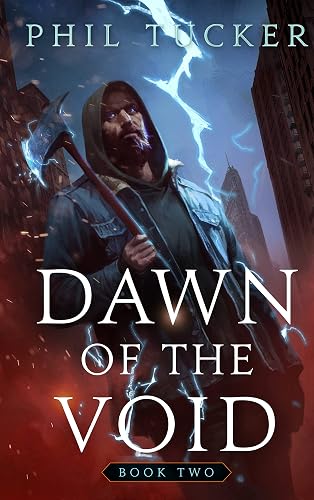
The setup: a system-flavored apocalypse hits Earth in the form of a demon invasion from hell, and a homeless man lucks into killing one of the first demons, earning points, stats, and abilities that put him on the path to becoming the spearhead of humanity's resistance. If that reminds you of Defiance of the Fall's Earth arc, it should, this reads like Tucker enjoying that flavor of story and writing his own, except our lead has people around him from the start rather than Zac's long solo stretch.
What Tucker does best
The standout of book one is the human response. Tucker writes the world's reaction to the apocalypse with real accuracy: the conspiracy theorists insisting it's a government front, the people who simply refuse to adapt, the early adopters racing to share information, the petty tyrants smelling opportunity. It's the most believable civilian-level apocalypse I've listened to in the genre, and it's carried by his usual strength, characters who are three-dimensional even in small parts, contributing to scenes rather than filling them. The demons themselves are creative and well-presented, the action is strong, and the whole thing moves with the tightness of an author who knew his ending before he wrote his beginning, because with a trilogy, he had to.
The Oreo problem
Now the structural note, because this series is my clearest example of what I call the trilogy trap. Book one takes you from normal life to the main character as a rallying pillar of the resistance. Book three is the invasion of hell's portal and the finale. Book two, therefore, exists to connect those two known points, it's the cream filling between the wafers, and once you know where a trilogy must end, the middle book can't truly surprise you. To be clear about the execution: book two is good. It's a war story, the resistance's first line of defense, battle to battle with interpersonal growth mixed in, never pointless grinding. I don't think it could have been done much better within the structure. But predictability seeps in anyway, because the destination is visible the whole way. The only trilogies I've seen escape this trap are The Perfect Run and the Licanius Trilogy, where I genuinely couldn't predict the endings, so the middle books kept their power to shock. Those are the exceptions that prove how hard it is. Dawn of the Void doesn't escape the trap; it just furnishes the inside of it very well.
If I stretch for a second critique: there are no firsts here. No new take on demons, no power set you haven't met. It's well-trodden ground, walked well, and I never punish a book for that when the execution earns it. This one does.
Verdict
Worth the credit. A-high. Tucker's second-best work after Immortal Great Souls, and comfortably ahead of Gods of the Game in tightness. Light LitRPG elements and a clean three-book commitment make it a good early pick for someone new to the genre who likes the sound of Earth-versus-hell, and the narration is strong throughout. If you want to feel the difference between a very good trilogy and a miraculous one, run this back to back with The Perfect Run; you'll hear exactly where the Oreo filling sits in one, and doesn't in the other. Meanwhile, I owe this series an ending, and it'll get one.
Reading order
Books in publication order. Cover links go to Amazon, affiliate-tagged, so you get the book and I get a small cut.

If you liked this, try…
- Defiance of the Fall — the Earth Arc (Books 1–3) is the most direct comparable on the site: system activation, demon invasion, humanity organizing resistance. Same genre DNA, very different scale and density. Defiance sprawls across a far larger book count; Dawn compresses the same essential arc into three tight volumes.
- The Primal Hunter — shares the Earth apocalypse premise but diverges immediately: the MC gets pulled into a tutorial and then a wider multiverse within the first book. Same starting point, very different trajectory.
- The Perfect Run — not system apocalypse, but the counterexample I reach for when discussing trilogies that avoid the middle-book trap. The Perfect Run keeps surprising in its second act; Dawn of the Void Book 2 is well-executed but structurally predictable.
- Gods of the Game — Phil Tucker's other series on the site. Different subgenre entirely (sci-fi gladiatorial LitRPG), but the same authorial fingerprints: clean prose, above-average character depth, purposeful pacing.
- The Immortal Great Souls — Phil Tucker's best work, in my view, and the ceiling to calibrate expectations against. If you loved Dawn of the Void and want to see where Tucker's writing goes at full stretch, start here.
Content notes
Combat violence throughout, including large-scale demon combat and mass casualty events. Strong profanity (multiple reviewers flag frequent language). Apocalyptic themes including societal collapse and civilian death.
Frequently asked questions
How LitRPG is this?
Does Book 2 drag?
Is this a good first system apocalypse series?
How does this compare to Defiance of the Fall?
Why A-high if I didn't finish the series?
Read next
Worth the Credit verdicts (B-tier and above). Scroll the carousel for more.