Isekai
He Who Fights with Monsters Review: My Favorite Series, And One Real Audiobook Warning
The series that started all of this
He Who Fights with Monsters is my favorite series, full stop, and the one that got me into LitRPG. I'd never heard of the genre; this series just kept surfacing with an astronomical number of Amazon ratings, so I tried it on a whim, and I was addicted immediately. Years and a few hundred audiobooks later, it's still the one I measure everything else against. Dungeon Crawler Carl holds the Mythic tier because it's objectively the more flawless creation, but if you ask me what I love most, the answer hasn't changed.
One mystery I need to raise before anything else: the cover art. This series has some of the worst covers I've ever seen, art that alludes to nothing in the story whatsoever, and I say this as someone who absolutely buys books off good covers. Maybe it's an inside joke, maybe a Patreon supporter knows, maybe it's the author's cousin with a graphics tablet. Whatever it is, do not judge this book by it.
Jason Asano, the argument
Let's deal with the divisive part head-on, because this series has real haters, and they all cite the same reason: Jason Asano. He's smarmy, sarcastic, convinced he knows better than everyone in the room, allergic to humility, and constitutionally incapable of keeping an opinion to himself. The people who can't stand him aren't wrong about any of that. They're just wrong to let it stop them.
Here's the pattern I've noticed across the genre's best series: each one has a single larger-than-life character who eats every scene he's in. In Primal Hunter it's the Malefic Viper. In Cradle it's Eithan. Usually that character is a secondary figure, someone so powerful nobody can tell him to behave. HWFWM's version is the protagonist, which means the scene-stealer never leaves the stage, and long before he has the power to justify the attitude, he's carrying himself like he does. For me, that's the engine of the whole series. And the banter is aimed dead at people like me: I did not expect any book to contain this many Airwolf jokes, let alone sincere debates about whether multiple helicopters improved or ruined the franchise, plus Knight Rider, Hasselhoff, and a hundred other deep-cut references. If that humor lands in your generation-shaped brain, this series is a gift. If it sails past you, I understand docking a tier; you're missing a real percentage of the jokes.
Real people, and tropes that swerve
My bar for S-tier writing is characters who feel like real people who exist somewhere, and this series set that bar. It goes beyond Jason's team: the tailor Jason gets his adventuring wardrobe from, the Adventure Society administrators, Rick Geller, characters who appear for a few chapters and vanish for books, all of them feel like people with lives running offscreen. When the party splits up, goes on side contracts, or wanders off into their personal lives, every thread stays interesting, like you're watching a sitcom set in a magic world. I never skip chapters in this series. There are no wasted ones; even the monster-grinding happens inside a plot that's visibly moving, and Shirtaloon never fills pages.
The other signature move: Shirtaloon dances deliberately close to LitRPG tropes, lets you think you know exactly where a plotline lands, and then swerves somewhere more authentic. Crucially, it's never subversion for its own sake, the thing I called out in my All the Skills review as the fastest way to wreck a story. Here the swerve always comes from character: you know these people so well by then that when they refuse the choice the trope demands, you understand precisely why. Fans of the series know the moments I mean. I'm not spoiling them.
And I'll disclose the taste driving all this praise: I listen for escapism. There's a whole audience for grimdark realism where everyone loses and even victory costs more than it pays, and that audience is welcome to it; I want to watch characters I love earn their way to something good. HWFWM is serious, it's frequently dark, people die, and it still fundamentally believes in its people. That's my kind of story.
The fans vs. me
The big community complaint, the one you'll find in any thread about this series: books four through six, when Jason returns to Earth. People love the series until that arc, then claim it derails everything. Look. Every isekai reader has wondered what it would look like if the transported hero went home with all his otherworldly power. This series is the one that actually shows you, it commits to the consequences, and it's done really freaking well. The people who hate the Earth arc are just wrong, and frankly they make bad life choices and shouldn't be listened to on other subjects either. It shifts the momentum, yes. It also deepens everything that comes after. I'll die on this hill; the view is good up here.
The one real flaw: an audio war crime
Now the honest part, because this flaw is serious if you listen rather than read. In the early books, every ability use comes with its full description, thirty seconds or so, every single time. Characters use abilities constantly, and abilities are designed to chain, so the descriptions chain too. I'd guess five to seven hours of book one's thirty-hour runtime is repeated ability text. And it compounds: as abilities rank up, the descriptions grow, until by the middle books a single ability can run five or six minutes, and Jason's synergy chains mean you hear several in a row. You will need your finger on the skip button, thirty seconds at a clip, sometimes three or four minutes, or the repetition will genuinely wear you down.
Around book nine they finally fixed it, descriptions moved to a glossary, abilities just get named, and it is practically a war crime that it took nine books, because after hearing an ability twenty-five times you know damn well what it does. To be fair about blame: this is an audio-format problem from LitRPG publishing's early days, not a storytelling failure, and it costs the series nothing if you can skip freely. But if your listening happens somewhere hands-free, save this series for when you can reach your phone. I'd love to see remastered early books someday; new listeners deserve the fix veterans didn't get.
Verdict
Absolutely worth the credit. S-peak, and the sentimental top of my entire catalog. Heath Miller's narration deserves a line of its own: his Jason is definitive, and the banter lands because the delivery does. Thirteen books and counting with no bad entries, a cast with no dead weight, and the best protagonist-carries-everything act in the genre, as long as the protagonist doesn't grate on you, and even if he does, give him three books to earn it. I hope you enjoy it as much as I have, and I say that knowing nobody can enjoy it as much as I have.
Reading order
Books in publication order. Cover links go to Amazon, affiliate-tagged, so you get the book and I get a small cut.

He Who Fights with Monsters

He Who Fights with Monsters 2

He Who Fights with Monsters 3

He Who Fights with Monsters 4

He Who Fights with Monsters 5
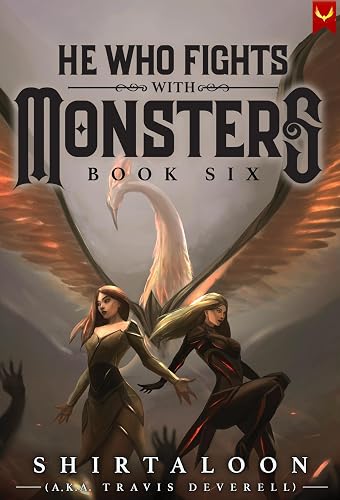
He Who Fights with Monsters 6

He Who Fights with Monsters 7

He Who Fights with Monsters 8

He Who Fights with Monsters 9

He Who Fights with Monsters 10

He Who Fights with Monsters 11

He Who Fights with Monsters 12
If you liked this, try…
- Dungeon Crawler Carl — Matt Dinniman (the other S-tier entry tied for my all-time favorite — see the full DCC review for the case)
- Cradle — Will Wight (for what a scene-stealing supporting cast looks like at the same level; the Eithan-as-comp for what HWFWM does with Jason directly)
- Primal Hunter — Zogarth (for the Malefic Viper, the other genre-defining scene-stealer; HWFWM puts that character archetype in the protagonist seat)
Content notes
Combat violence throughout. A divisive protagonist whose personality some readers find genuinely off-putting, see the body. The ability-description audiobook-production issue documented in the dedicated section below is the only craft warning that's actually about production rather than story.
Frequently asked questions
Is this really your favorite series?
The covers are bad. Should I be worried?
Is the Jason Asano divisive thing real?
Is there really an audiobook problem I should know about?
Read next
Worth the Credit verdicts (B-tier and above). Scroll the carousel for more.