System Apocalypse
Dungeon Crawler Carl Review: The Series That Gets Its Own Tier

The top of the mountain
This will be a shorter review than you might expect, and the reason is simple: Dungeon Crawler Carl is the peak of the genre. To quote Bret Hart, the best there is, the best there was, the best there ever will be. This is the series that made me build a tier above S, because after enough reviews it became obvious that every scale needs a ceiling, and this is the ceiling. One book series lives in Mythic. This is it.
I found Carl through a recommendation in my earliest days with LitRPG, a handful of titles into the genre, and I had never heard a story like it. Years and a couple hundred audiobooks later, that's still true.
The soup that shouldn't work
Here's the pitch problem that kept me from successfully recommending Carl to friends for years: the ingredients sound insane together. Earth is annihilated overnight and the survivors are herded into an eighteen-floor dungeon, which is also a galactic reality show. It's a horror story, a genuine tragedy where most of humanity is already dead, and it's simultaneously the funniest thing I've ever listened to. The aliens producing the show have a Jersey Shore-level understanding of the species they're exterminating, and they present the crawlers to the universe as ridiculously as possible, so you get absurd high-stakes boardroom scenes where executives debate manufactured scandals and editorial authenticity while planning the annihilation of a world. You shouldn't be laughing. A lot of people are going to die. You cannot stop laughing.
Matt Dinniman takes concepts that have no business coexisting, Survivor plus a post-apocalyptic Pokemon card game is a real floor theme, and makes them horrifying, hilarious, and brilliant at once. That's the trick nobody else can do, and it's why anything that tries will just be derivative of Carl.
The cast
Carl himself is a great protagonist, but the bench is absurd. Princess Donut might be the funniest animal character in anything, books or movies. My personal favorite is Prepotente; I cannot get enough of him. Even the throwaway characters land: shout-out to Quasar, who reads like Matt Dinniman took Saul Goodman and made him a chain-smoking Bronx fixer for the Italian mob. Nobody in this series is a trope. Characters you'd swear were introduced to annoy you develop real depth, and the aliens working the dungeon carry a quietly devastating detail: for Earth this is the apocalypse, but for them it's a shift at work, their thirtieth or fortieth world-annihilation, just punching the clock toward buying their own freedom.
And then there's the AI running the dungeon, which is both the most evil and the funniest thing in the books. It's the worst kind of evil, the casual kind: not malicious, just completely indifferent, a machine trying to entertain itself with no morality in the loop, groping for emotional experiences it doesn't have and can't name, all-powerful within its sandbox, with everyone we care about stuck inside the sandbox. There are hints it's something even the aliens don't actually understand. Every scene it touches is a highlight.
The fans vs. me
Even Mythic gets discourse, so here are the two recurring points and where I land.
"Some books spend too much time on side characters and floor gimmicks." The clearest version targets the card-game floor: the deck mechanics aren't essential, the same plot beats could land without them, and time spent on card rules is time not spent elsewhere. I can't say that's wrong. I just think it misses what the floors are for: the themes are supposed to be outlandish, and the absurdity is load-bearing. And Dinniman has earned trust that time spent is rarely wasted; the story moves floor to floor on literal death timers, so it's a roller coaster that never gets slow, and some threads you're curious about simply never get room. That's the cost of the format, not a flaw in it.
"Carl is an unreliable narrator." I keep seeing this presented as a gotcha, and I find the whole framing pointless. Of course he's unreliable. Every first-person story is; human memory fills in gaps, perception gets tricked, and this series has aliens who probably perceive spectrums Carl can't. If Dinniman is using the point of view to mislead us, it's for a payoff, and I don't feel cheated in advance. Some readers love treating a book as a puzzle to solve ahead of the author, and if that's your fun, no judgment. I'm here to go on the ride.
While I'm near the topic: the unreliable-narrator discourse got big around Name of the Wind, and I have no patience left for that situation, or any author who builds a fanbase on a promised story and then leaves it unfinished for decades. Dinniman is the opposite case: books keep coming, the end is announced, and the man clearly respects his readers' investment. That matters to how confidently I can recommend a long series.
Why Mythic and not just S
He Who Fights with Monsters is still my personal favorite series; I'll say that openly. But objectively, Carl is better, and the difference is that I can't find anything to cut. Every other series on this site, including the ones I adore, has a weak book, a divisive arc, a character the cast would survive without. Carl has nothing I would remove and nothing I would change. Dinniman doesn't over-explain his universe (the technology is beyond us, that's the explanation, and the story is better for refusing to nanobot its way through the how), the pacing never sits down, and the humor and tragedy keep landing harder as the stakes rise.
Then the whole thing goes to Jeff Hays and Soundbooth Theater, and the best story in the genre gets the best narration in audiobooks, full stop. If you've never watched Hays do a line read on social media, transitioning between a dozen voices in real time, go watch one; the polish Soundbooth puts on these productions is the industry ceiling. A perfect story with perfect narration: that synergy is what Mythic means.
Verdict
Worth the credit is an understatement; it's worth two or three of them, so if the series is on sale when you read this, just buy all of it. You will not be disappointed. If I could recommend only one audiobook out of everything I've ever covered, to any person with any taste, it's this one, and I've watched it convert people who don't like fantasy, don't like horror, and don't like game mechanics. The only people I've met who dislike Carl are the ones who decided to be contrarian about anything popular, and they've chosen to live their lives in a state of being wrong.
One honest warning for newcomers: if Carl is your first LitRPG, everything you try afterward will feel a little inferior, because you started at the summit. Go in with eyes open, keep a palate cleanser ready, and remember the rest of the genre is still great. It's just not this.
And that is it for Dungeon Crawler Carl.
Reading order
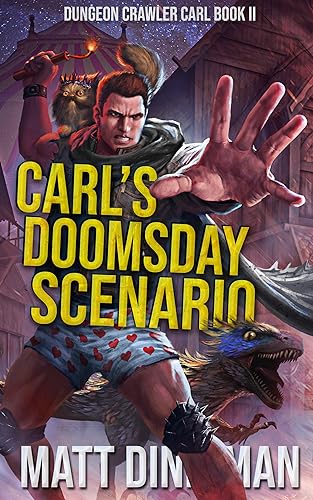
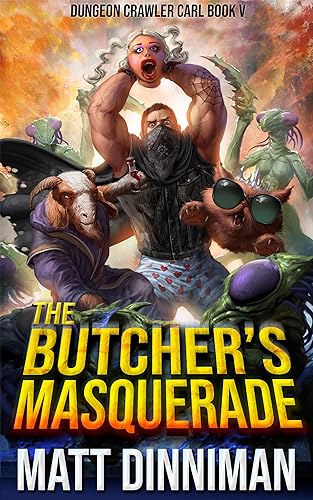
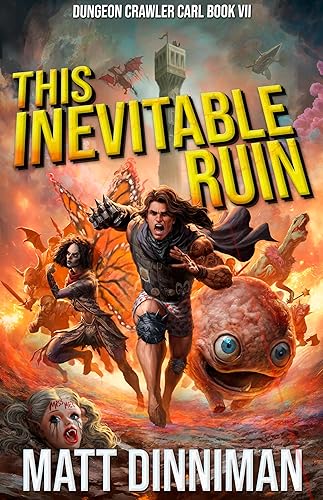
Books in publication order. Cover links go to Amazon, affiliate-tagged, so you get the book and I get a small cut.




If you liked this, try…
- He Who Fights with Monsters — Shirtaloon (the closest analogue at the top of the genre, and still a clear step below)
- Defiance of the Fall — TheFirstDefier (system-apocalypse sprawl, no satire)
- Apocalypse Parenting — Erin Ampersand (the absurd-apocalypse tonal sibling, much smaller scale)
Content notes
Frequent strong language; grim and grotesque violence; running animal-in-peril gags that get genuinely upsetting; reality-TV satire that gets dark fast. The horror and the comedy occupy the same sentences; that's the point of the book, not a tonal misstep.
Frequently asked questions
What is Mythic? It's not on the rest of the tier scale.
Is the series finished?
Do I need to read the books in order?
Audiobook or ebook?
I've tried to recommend this to friends and they didn't bite. What pitch actually works?
Does it stay this good across the series?
Is this a good first LitRPG?
Read next
Worth the Credit verdicts (B-tier and above). Scroll the carousel for more.