LitRPG
Everybody Loves Large Chests Review: Rooting for the Monster
Read the content warning above before anything else in this review. I mean it, and I'll say it again at the end, because this is the series I debated hardest about where the warning even goes.
Now, with that settled: Everybody Loves Large Chests is one of the most original things I've listened to in this genre, and I went back and forth on whether it belongs at the very peak of my rankings. The reason it doesn't has nothing to do with quality.
The monster's point of view, actually done
The series follows Boxxy, a mimic. Not a monster with a heart of gold, not a monster that adopts a child and learns the meaning of friendship. A monster, doing monstrous things, for monster reasons. Boxxy starts as a basic dungeon mimic with an intelligence stat of one, and book one is his origin in the truest sense: you're inside his instincts as an ambush predator while he develops, point by point, something resembling a mind.
Most authors can't write outside a human point of view; Iliev somehow captures the instinctual logic of a creature learning the world from zero, and keeps the internal monologue so ironclad-consistent that Boxxy's thinking feels authentically alien. Over and over, he does something that looks baffling, you get his reasoning, and you realize you were the one thinking about it wrong. It feels like listening to another species, and I can't name another book that pulls that off.
Monster doing monstrous things
Here's the part the content warning is about. Boxxy kills a lot of people, and worse. There's torture, body horror, and sexual violence that the book does not fade to black on, largely in the context of monsters and demons doing what those creatures, as written, would actually do; his succubus familiar and his fiend are exactly what their natures say they are, and Boxxy learns that certain awful tools are effective tools, because nobody in his orbit is preaching morality to a mimic. None of it is played for titillation and none of it reads like shock for shock's sake: it's the cost of an author fully committing to the premise. But it is very much on the page, and if that's a line for you, believe the warning and skip this one. Not every book is for everyone, and this series is the site's defining example.
What keeps it from being grimdark misery is that there is no malice in any of it. When Boxxy eats a captured enemy piece by piece, it's not sadism; he just likes that particular kind of human the way you like a good steak, and he wants to savor it. Horrific outcome, perfectly innocent monster logic. That gap is where the series lives.
The funniest horror in the genre
And the same gap is where the comedy comes from, because this is, no exaggeration, one of the funniest series I've listened to; only Dungeon Crawler Carl has made me laugh harder. Where Carl plays comedy against tragedy, this plays comedy against horror, and yes, the title is literal: expect every chest joke you're currently imagining, executed better than it has any right to be. The supporting cast of demons and familiars, each one written to its nature with total commitment, generates half the laughs, and even my least favorite of them, Fizzy, who I initially wrote off entirely, became a character the story would be worse without.
No wasted pages, no plot armor
The craft claims, plainly: there are no bad books in this run, no grinding arcs, no training montages, and no contrived plot points. Boxxy is never chosen by a god, never finds a mythical bloodline; he's an ambush predator who has to score big hits early or die, and the story stays grounded in that logic even as he grows. His double life, a monster maintaining cover identities among people because discovery means every power in the region hunts him down, keeps real stakes on the board deep into the series, because for almost the whole run there are things in the world that can absolutely kill him. Around book five the series even runs a regression beat, and, like TBATE, resolves it in exactly the right amount of time instead of wasting a volume on it.
Jeff Hays and the Soundbooth cast, with Annie Ellicott across the run, deliver what might be the production of their catalog: the sound design makes the horrific more horrific and the funny funnier, and I say that knowing full well what else Hays has narrated.
Verdict
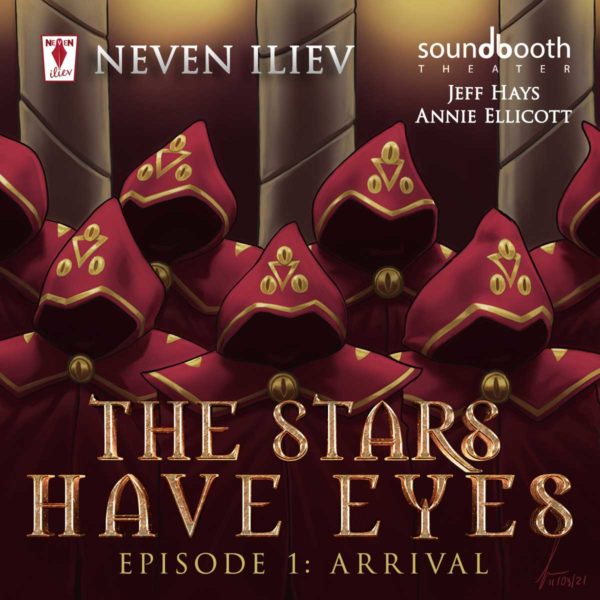
Worth the credit. S-high. On craft alone this argues for peak: I cannot point at one thing the series does badly, and originality this complete is the rarest thing on my shelf. What holds it at high is the honest fact that peak, on this site, signals a series I can hand to anyone, and this one I can only hand to listeners who've read the warning and nodded. If Iliev sticks the ending, I reserve the right to promote it anyway. And if you want proof the man's talent isn't the shock value: he also wrote The Stars Have Eyes, the single most wholesome thing on this site. Same pen. I still don't quite believe it.
Reading order
Books in publication order. Cover links go to Amazon, affiliate-tagged, so you get the book and I get a small cut.

Morningwood

Fizzlesprocket

Vortena

Morgana

Teresa

Mortimer

Goroth

Stain

Jackson

Law

Tol-Saroth

Hazalag (Kindle ahead of audio)

Aboxageddon (Kindle ahead of audio)
Morningwood and Vortena: Kindle release date. These volumes were re-issued and the earlier audio edition delisted, so the store now shows only the re-issue (October 10, 2025). The Kindle date is the closest verifiable stand-in and keeps the series in order.
If you liked this, try…
- Dungeon Crawler Carl — the only series that has made me laugh as hard; Carl mixes comedy with tragedy, this mixes comedy with horror, and both come out the other side as something singular
- Overlord — the other genuinely-a-villain protagonist; Ainz slaughters kingdoms and you root for him anyway, which is exactly the trick Boxxy pulls with none of the undead middle management
- The Stars Have Eyes — same author, opposite pole of the universe: a wholesome no-stakes rom-com, and proof Iliev's talent isn't the shock, it's the craft
Content notes
The most extreme content on this site. Graphic violence, body horror, torture, cannibalism, and on-page sexual violence that does not fade to black, all presented as monsters being monsters. Do not start this series unless you have read this warning twice.
Frequently asked questions
How extreme is the content, really?
Why S-high and not S-peak?
Is Boxxy evil?
Where should I start, and how long until it hooks?
Read next
Worth the Credit verdicts (B-tier and above). Scroll the carousel for more.