Cultivation
Apocalypse Cultivation Review: A Great Book One and a Book Two That Wanders Off

I bought book one a long time ago and forgot about it, because I assumed the series was dead. Then I saw a post from Blaise Corvin saying he intends to finish everything he has started, and finally gave it a go.
Book one is one of the more pleasant surprises I have had this year. Book two is one of the more frustrating.
The apocalypse that does not ramp up
Most system apocalypses give Earth a tutorial. A grace period, scaled encounters, a system that wants humanity to have a fighting chance.
This one does not. Earth has been hidden from the wider multiverse behind a veil, and when that veil is pierced every dark god with an interest arrives at once, wanting their slice. Nothing is calibrated to human capability. There is no ramp. The opening is a slaughter, and the story is completely upfront that the residents of Earth are on the losing side of it.
That choice pays for itself immediately. Named characters die in the first act. The scale of the thing is legible from the start.
Jake leads a small mercenary team, competent by human standards and hopelessly outclassed by what has arrived. He and his team are betrayed and dumped on a hell world, where matters are considerably worse than on Earth. The book does not linger there. Events on the hell world put Jake in front of a god, and the god offers to send him back to just before the system reached Earth.
He takes it. He does not get his body back.
The zombie is the whole idea
He wakes up as a zombie.
This is the best decision in the book and I want to be specific about why, because "the protagonist is a monster" is not by itself unusual. What is unusual is that the monster is genuinely bad at being a person. The zombie is slow. Its senses are dull. Thought comes at a crawl. Jake has his mind, and a mind is very little help when the body running it is this stupid.
So the early stretch is a capable man trying to fight and cultivate through a vehicle that fights him back, and it is both grim and quietly funny. The undead body has real advantages he learns to exploit: it does not feel pain, it does not need food. Those are cultivation advantages, and the book works them properly rather than waving at them.
Then he evolves into something better, and the series leans harder into the part that makes it work. He is horrific. He is terrifying to look at. And he is trying to save people who have no reason to think he is anything other than another monster eating their neighbors. That tension carries most of the book, and I have not read it done this way anywhere else.
Book one closes on him bound to the Morrigan as his patron, having foiled the god who destroyed his hometown. It is a real ending to a real arc.
And then book two leaves
Book two opens by pulling Jake off Earth onto a prison world, and stays there.
If that shape sounds familiar, it should: it is the Orm world arc from Defiance of the Fall, which is one of that series' weaker stretches for the same reason. What saves Orm in Defiance is everything happening outside it, the powers of the multiverse scrambling over Zac while he is unreachable. Apocalypse Cultivation has none of that yet. Jake is unknown. The gods are barely sketched. So the prison world is just a prison world, and the characters he meets there are flat enough that the one who follows him out does not feel like a gain.
There is a stretch of maybe thirty percent in the middle where divine intervention drops him back on Earth, and the book instantly becomes good again. Same tension, same monster-among-the-people friction, same reason to keep listening. Then it ends and he goes back.
After the prison comes a geas to seek out a sect, which means a cross-country trip, which means the next zone. He happens to need a very particular environment to reach his next cultivation stage, and the person he escaped with happens to know exactly where it is. He gets there and there is a guardian, so there is a side quest to gain entry to the side quest. Then a dozen chapters of exploring a ruin.
None of it is badly written. The fights are staged properly, the encounters vary, the aftermath is summarized rather than itemized, and for the first hour I did not clock what was happening. It is just that none of it matters. Jake gets stronger and the plot does not move. I put it on 1.25 speed, which I almost never do, and I did not miss anything.
The final fight of the prison arc is genuinely good. It is also a five-minute payoff at the end of a three-hour approach. I appreciate that the author wrote it. I did not need the walk.
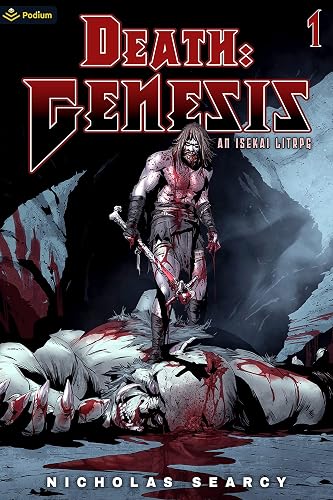
It is not as punishing as Scorio breaking rocks in Immortal Great Souls, though the mining-quota stretch gets close. The better comparison is the prison arc in Death: Genesis, which is also full of manual labor and works anyway, because the people Zeke meets in there matter later and what happens inside feeds the next arc. Here, the rocks are just rocks.
The knowledge problem
One thing nagged at me in book one and got louder in book two.
Jake always knows what he needs to know. How to evolve his path, which cultivation trade-offs are worth taking, how to use senses he has just acquired, how to read wards, how to address a divine being without being tricked by one, the customs of each faction he runs into. It is attributed to the master who trained him in his first life, or to briefings he read as a team leader.
You meet the master in book two, and meeting him makes it worse. He is the crotchety-old-teacher type who plainly could not be bothered to explain much, which sits badly against the amount Jake apparently absorbed in a short apprenticeship at a weak cultivation level.
It is the same device as the soul that lands in the protagonist's head in Dawn of the Density God: a delivery mechanism for knowledge the story needs the lead to have, doing no other work. Compare Beware of Chicken, where the two personalities sharing a body actually are the story for a long stretch, and converge slowly through the different choices each would make. That is the version where the device earns its place.
I forgave it while I was enjoying myself. I stopped forgiving it when I was not.
Practical listening notes
Luke Daniels narrates, and this is a standout in a catalog that does not lack for them. For a good portion of book one Jake cannot speak and communicates in writing; when the voice comes back it is grating and wrong in exactly the way it should be. Holding a lead role in that register for fourteen hours without it curdling is difficult, and he does it.
Book one runs 13 hrs 49 mins, book two 10 hrs 45 mins, both through Recorded Books.
Corvin has several other series, and the one I see recommended is Delvers, which I have not heard. On the strength of the writing here I will be trying it. The prose is good throughout. The problem in book two is structural, not sentence-level.
Where it lands
B-mid, and that is an average across two books that deserve different grades.
Book one had me thinking A band. It is fresh in a genre where that is hard, it commits to a premise most authors would soften, and it paces well enough that I never drifted. Book two is a long side quest with a good short story buried in the middle of it.
Listen to book one and stop. It resolves enough to satisfy. Book two only makes sense as setup, and setup is only worth paying for once you know what it set up.
The silence, and why I am not blaming anyone for it
I have this at hiatus rather than ongoing, and the distinction matters if you are deciding whether to start.
Book two came out in May 2023. Nothing since. Corvin said on Reddit about a year ago that he intends to finish everything he has started, and pointed people at his Patreon and mailing list for anything more current, so this is not a writer who has quietly walked off. But an intention stated a year ago is not a release date, and three years of silence is three years of silence.
He has also been open about why series stall, and his answer is the honest one: when a book does not sell, an author writes what does, because that is what pays the bills. I have no argument with that. Writing full time is a job and a series that is not earning is a series that costs its author money to continue.
It is still the thing you need to know before spending a credit. The same economics that stalled this series once apply to it now, and book two has drawn about a quarter fewer Amazon ratings than book one, which is a rough proxy for reach rather than a sales figure but is not the signal that reverses anything.
I will pick up book three when it arrives, because I want to know whether Corvin brings Jake back to Earth and back to the thing that worked. If book three is another sect arc of grinding levels, this drops to a skip and I will say so. A series cannot survive two of those in a row.
Verdict
Worth the Credit for book one, without hesitation.
Book two is a maybe, and only with your eyes open: you are buying a credit for roughly a third of a book, and the rest is the character sheet going up.
Reading order
Books in publication order. Cover links go to Amazon, affiliate-tagged, so you get the book and I get a small cut.

Content notes
Heavy casualty apocalypse: named characters die fast and often, including civilians, and the early chapters are deliberately a slaughter. Body horror throughout, since the protagonist spends the series as an undead monster and the text does not soften what that looks like. Torture and captivity in the book-two prison arc.
Frequently asked questions
Where does Apocalypse Cultivation rank on this site?
Should I read book one on its own?
Why is the protagonist a zombie?
Is the cultivation crunchy?
How is Luke Daniels on this one?
Is the series abandoned?
Why did it stall?
Read next
Worth the Credit verdicts (B-tier and above). Scroll the carousel for more.