LitRPG
Rogue Ascension Review: The Pacifist Kraken Merchant Was Too Much

Everything up front, for no reason
I think I knew I wasn't going to like this one from the premise. Everyone on Earth gets pulled into Multiverse Z, a set of game-like magical realms, and eighteen-year-old Joey Eclipse finds himself facing a series of choices about the kind of life he'll have. As I understood it, you can take a low-status life where most decisions are made for you and you'll never achieve anything, but it'll be easy. You can take the path most people choose, something like a farmer or a mid-rank crafter, safe from danger but with next to no personal power. Or you can choose greatness: born into wealth or nobility, or with incredible talent as an adventurer, and the most risk.
He picks greatness, obviously. A rogue class, because he knows from MMORPGs that rogues give you the most flexibility and let you stay under the radar, plus abilities to hide himself, since being one of the great ones will make him enemies fast. And for his companion, a dragon, because why not give a level-zero newcomer a dragon? It all felt unbelievably contrived for no discernible reason.
I'm usually very forgiving when things fall into place a certain way to get the story moving. When it's done poorly, it's hard to get past. Giving the lead everything up front is a balancing act: he has S-rank abilities and he's still level one, so he can die to an ant. Some authors make that tension work. This one didn't, for me. It just felt unsatisfying.
The pacifist kraken
Then he's dropped onto a raft in the middle of the ocean, and his first major encounter is a kraken. A friendly kraken, because in this world krakens are pacifists, and pacifist merchants at that. This one is being harassed by crustaceans it can't deal with itself, so it enlists our hero to fight them off.
I usually appreciate an author taking a classic fantasy archetype and doing something new with it. I've seen orcs written around a strict code of honor and single combat instead of a green tide where the biggest biceps make you chief, and elves with their own societal twists. Even A Practical Guide to Evil, which I didn't enjoy, makes its goblins master crafters of a metal deep in their mines, which gives them something to trade and a tenuous place among the other races. That's a small detail that makes sense.
A pacifist kraken merchant doesn't. If krakens are prevalent enough to have a merchant society, there must be tons of them in every ocean. They're still incredibly powerful, because they're huge monsters. And who exactly is trading with them? Who met enough krakens to decide they're all pacifists and good trading partners? It's really dumb, and then you have to listen to the kraken explain how its society evolved, and all you can think is that it doesn't make sense. It's bad when a reader of a fantasy story thinks something is too ridiculous for fantasy. Even the negotiation didn't flow: he has to trust what the kraken tells him, isn't sure what to trust it with even after agreeing, and the inner monologue doesn't quite check out. I was too distracted trying to ignore how absurd it all was.
The writing
The author isn't a bad writer. It's average, in that two-and-a-half to three-and-a-half star range where everything feels flat. There are no run-on sentences, unclear descriptions or confusing dialogue, none of the hallmarks of poor craft. The writing is straightforward, which I don't mind; I'd rather that than an author flexing his vocabulary at me. But the dialogue is on the boring side, and with so many great authors in the genre, picking this up feels rough. It felt like it could be a self-published work with no editor or test readers, maybe an early work for the author. That's a guess, not something I know.
The narration
André Santana's narration is passable. Nothing stood out, but in four hours there weren't many voices for him to show range with, so that's a verdict on what I heard, not on him.
Verdict
Not worth the credit. D. I made it about four hours, maybe five, and gave up. Nothing in it is bad, wrong or broken, and executing an idea poorly doesn't make the writing bad. I just couldn't get past what felt like absurd choices, one after another. The series has a lot of reviews and eight books, and fans who say they really enjoy it, so it clearly has an audience, and it's possible it gets better further in. For me there's just a lot of other stuff out there I'd rather listen to than keep slogging through this.
Reading order
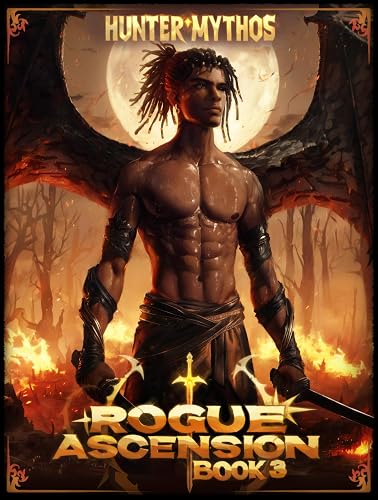
Books in publication order. Cover links go to Amazon, affiliate-tagged, so you get the book and I get a small cut.



If you liked this, try…
- Accidental Champion (Todd Herzman) — the other book one I gave up on quickly for a contrived start; it's the better of the two
- A Practical Guide to Evil (David Verburg) — a book I also didn't enjoy, but one that reinvents a classic monster race in a way that actually makes sense
Content notes
Combat against monsters. Nothing graphic in the part I heard.
Frequently asked questions
What is Rogue Ascension about?
Why did you stop so early?
Is the writing bad?
Read next
Worth the Credit verdicts (B-tier and above). Scroll the carousel for more.