Isekai
Last Life Review: S-Low Progression Fantasy, and the Closest the Genre Has Come to Game of Thrones

Getting the translation stuff out of the way
Last Life is written by Alexey Osadchuk, and I'll be upfront: I'm not sure how his last name is pronounced, and the series is translated, I believe from Russian, by Andrew Douglas Schmitt. You notice the translation. Certain phrases and constructions get reused almost incessantly; whenever the author needs to hand you exposition, brace for a "by the way" and a quick info dump. I try not to hold this against the story, because I have no idea what carrying prose across languages does to it, and it may read completely differently in the original. Here's my honest rule of thumb, and it applies to more than translations: when I'm not enjoying a story, issues like this eat at me. When I'm loving one, I look right past them. I love this one, so I look past them.
The setup
Max, who went by Dodger in his old life, gets reincarnated, transported, isekai'd, pick your term, into the body of a noble family's bastard whose name is in the absolute gutter: a party animal who blew through money and burned every bridge available. So book one opens with a reputation rebuild, and it moves immediately, because Max arrives as an adult who was already something dangerous in his old world. You never learn precisely what, assassin, fixer, some flavor of mastermind who lived on the edge and did things that weren't strictly legal, but it doesn't matter. What matters is he arrives as a meticulous planner used to being the smartest person in the room, with more knowledge of how magic actually works than the natives of the world he lands in.
Yes, that means he has Mary Sue tendencies; he rarely missteps and usually knows more than his enemies. I don't mind when this is done well, and here it's earned by the backstory instead of handed over for free. Some authors want to tell the story of the apex predator temporarily knocked down a peg. It's their story. As long as it's done well, I'm in.
And I have to praise how fast the setup completes. Within five or six chapters you have his origin, his magic, his goals, and the first seeds of the plots against him. Compare that to the boy-on-the-farm era of fantasy, and I say this as someone who did Wheel of Time back in the day, which was freaking rough: six hundred pages of lost sheep and village life before the plot moves. Last Life jam-packs the opening chapters with what you need and then gets on with it. An entire book of story ahead of you by chapter six. I love authors who do this.
The Game of Thrones thing
Here's the reason this series rates so high for me: it's the first LitRPG-adjacent story I've found that nails the political intrigue George R.R. Martin was known for. Nobility actually matters here. Nobles have different rights and privileges, the families are vipers in a nest of vipers, and reputation is a weapon with real edge.
The structural reason it works: there are no god-tier existences in this world. The king is a mortal man with strong magic and maybe an extended lifespan, worried about his legacy and his children like any ruler in history. And as powerful as the top magic users get, they cannot fight an army. That single design choice changes everything. In most LitRPG, once your faction is backed by something like the Malefic Viper, politics stop mattering because nobody offends the Malefic Viper. Here, power stays human-scaled, so alliances, perception, and reputational attacks carry the weight that raw cultivation carries elsewhere. A minor character Max brushes past in book two can resurface books later wielding real political influence, sometimes to his benefit, sometimes very much not.
The magic stays out of the way
The LitRPG elements are deliberately subdued. There are ranks of power, five, six, maybe seven, I don't think the author has ever pinned the full ladder down, and that's it. No skill lists, no technique names, no stat screens. After a couple hundred books in this genre, I'll tell you my secret: I just don't care how the magic works. It's magic. I'm fine. Give me enough to know where characters stand relative to each other and spend the pages on story.
One example of how well this series handles it: healing. In this world, healing magic is just an unguided mana you dump on wounds, and the best healers are the ones who've seen the most patients and learned by trial and error, medieval doctors with a glowing shortcut. Max arrives with modern medical knowledge. He knows to clear infection, set bone before muscle, repair arteries before skin, so when he directs the same magic everyone else fumbles with, he's the best healer in the series. No levels, no titles, no grinding cure-wounds ranks. Call it hand-waving if you want; for me it's a clean explanation delivered once, in a chapter or two, and every heal afterward just works. Swordsmanship gets the same treatment: one focused stretch that lays out his style and the path he's training along, and after that you get a paragraph of progress here and there instead of endless cutting practice. Explain once, then move on. More series should steal this.
Pacing, and my one real complaint
The author routinely skips downtime. If the important thing ends in one chapter and the next important thing is three months out, the next chapter is three months out, with maybe a line noting things progressed normally on Max's land. Nothing gets padded. I sometimes judge books by the old movie standard, that no scene should be removable, and while Last Life isn't quite that lean, it's closer than almost anything else I've listened to in the genre. Every chapter moves the plot, exposes another player's scheme, or plants something that pays off later.
The prose runs lean on description too. If a scene is Max talking to his butler, it opens with the butler walking through the door; you got the office described once, back in book one. If you're used to a Sanderson, or Jim Butcher painting every room in the Dresden Files down to the grain of the desk, this will feel spare. Between that and the translation, it's a fair knock.
My one real complaint: the names. The houses run French- and Italian-sounding, a lot of the surnames are similar, and with roughly a year between audiobooks I genuinely struggle to remember which character belongs to which house and how the houses relate. Someone binging all twelve books straight through will have a much easier time than I did picking up threads a year apart. It might be the translation dropping the little reminder cues authors usually weave in. Either way, keep a mental map.
The book-one test
Here's the most useful thing I can tell you about Last Life: it is a very particular product, and it delivers the exact same product every single book. Same balance of plot, intrigue, lean description, and subdued mechanics, every time. So whatever your reaction to book one is, that's your reaction to the series. If you love it like I do, you'll love all twelve. If book one was merely fine, book two will be merely fine. And if you finish book one missing your skills, levels, dungeon dives, and empire building, stop there, because none of that is coming. That's okay. Not every book is for everyone. But don't push to book two hoping it turns into a different series.
Where it ranks
This is where I have to be honest about my own scale, because this grade has moved. Part of me always wanted this in S tier: it hits almost everything I personally want out of a story, fast setup, relentless plot, politics with teeth, magic that stays out of the way. I'm the guy buying every book on release day. Twelve books in, there are no weak entries; my only gripe is some run short and I wanted more.
What kept it parked at A-peak for a while was the prose: repetitive word choices, sentences that run weak, and I could never decide how hard to grade that when I can't tell whether it's Osadchuk or the translation. Then I reread my own Solo Leveling verdict, where I called that exact critique a translation tax and graded the story instead of English prose it was never written in. The same rule has to apply here or it isn't a rule. And the story clears my own S bar: every S-tier series needs one thing it does better than everything else, and nothing in the genre touches Last Life's political intrigue. So: S-low, the doorstep of the S shelf, held there rather than higher by the prose question I still can't fully acquit, with room to climb if Osadchuk sticks the landing whenever this ends. The story shows no signs of wrapping up anytime soon, so I'll have plenty of books to argue with myself through.
Absolutely worth the credit.
Reading order
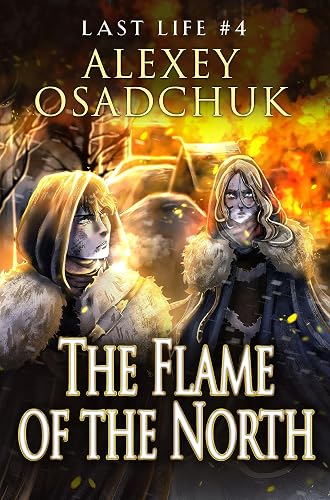
Books in publication order. Cover links go to Amazon, affiliate-tagged, so you get the book and I get a small cut.




If you liked this, try…
- The Stubborn Skill-Grinder in a Time Loop — X-RHODEN-X (the closest in-genre comparison: info-packed opening, story-forward discipline, author has something specific to tell)
- He Who Fights with Monsters — Shirtaloon (pacing contrast — both excellent, Last Life moves faster to the story)
- Cradle — Will Wight (same — top-tier pacing in both, Last Life is tighter on the origin)
- George R. R. Martin / A Song of Ice and Fire — for what noble-house political intrigue looks like when no one in the world is powerful enough to make politics irrelevant
Content notes
Combat violence, political intrigue with real consequences (deaths, betrayals, faction collapses). Reincarnation premise; the protagonist's prior-life identity includes an implied criminal/assassin background. Translated from Russian, prose-level friction noted in the review.
Frequently asked questions
Is there a map of the Last Life world?
Is this LitRPG or progression fantasy?
How bad is the translation?
Where does the series stand for buying every new book on release?
What is the Book 1 test?
Read next
Worth the Credit verdicts (B-tier and above). Scroll the carousel for more.