LitRPG
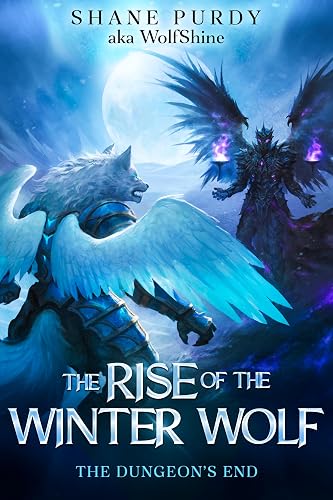
Rise of the Winter Wolf Review: The Game Show Works, the People Do Not

I picked this up for a stupid reason
Winter Wolf was my handle for years, back when I played World of Warcraft and everything before it, and the name came from a collectible card game called Rage. Rage was a werewolf CCG built almost entirely out of broken cards, and the fun of it was seeing who could assemble the most abusive deck. The Winter Wolf was my favorite piece of terrible rules design in the whole box. If you had more of one particular stat than your opponent, you played it and their alpha left the game immediately. In a game supposedly built around alpha combat, you could draw it on turn one and effectively win before your opponent took an action.
I have no idea whether Shane Purdy got the name from anywhere near the same place. But this book sat on my list for a long time on the strength of the title alone, and then somebody on the forums whose recommendations have worked out for me before named it when a thread asked for werewolf LitRPG. So I finally spent the sale price and went in genuinely excited.
Then I found out the main character is an ice mage.
The setup is the best thing in it
The initialization does not come to Earth. It comes to the galaxy. Every intelligent species in the Milky Way is picked up and put down on a new world, and it turns out most of what we filed under mythology, vampires and sirens and werewolves, was real and out there the whole time.
From that population, a thousand participants are selected at random for the administrator dungeon. It is a televised multiverse-wide game show, run across many floors, and the prize for the top finishers is the right to become an assistant administrator themselves. Sponsorships, notoriety, real power. It is also a meat grinder that almost nobody clears.
That is a good engine. It is also unmistakably downstream of Dungeon Crawler Carl, which I said in my own review was novel enough that things would come along in its wake. This is one of those things, and it is not close to the same quality. What it does have is one idea DCC leaves mostly offscreen, and I will get to it, because it is the reason this review is not a pan.
I found someone more boring than Zac
The main character's name is Wolf. Of course it is.
I may have found a protagonist with less going on than Zac from Defiance of the Fall, and I did not think that was available. Wolf has no personality. Not an unpleasant one, not a flawed one, none. You do not dislike him. There is simply nothing to catch hold of.
It gets worse rather than better, because partway in he takes a mutation that turns his blood to ice and makes him colder and more logical, which in practice means even less personality than he started with. His motivation for the whole book is to survive and get back to his family, which is reasonable and also the entire interior life on offer.
He is written as a near-total loner despite having a family and friends. When a close colleague talks to him, he wants the conversation to end. When his best friend shows up in town to surprise him, his first move is to interrogate why the guy is there. A childhood friend has been in love with him for years and he keeps brushing her off for no reason the book ever supplies. Once he is in the dungeon and other players try to work with him, he is standoffish with all of them. Some reserve makes sense in a competition where most entrants die. This is not reserve, it is a wall, and it means the book has no interpersonal development in it at all.
When another player does drag him into spending time together, the author writes a few lines of dialogue and then skips ahead two hours. That keeps the story moving. It also means almost every relationship in the book is made of small talk and a time skip.
The assassin family problem
Wolf and his entire family are assassins who worked for the US government. Black site, contractors, internal wet work, the book never says. They were getting out of the business around the time Wolf and his sister started college.
I understand what this is for. It is a fast way to hand the protagonist and everyone around him a high combat baseline before the system arrives, and I like a quick origin. This was too much even for me. His parents are established as extremely dangerous people and given nothing beyond a commanding air. None of them is remotely fazed by being abducted to another planet by an alien system and handed video game powers. They register it, accept it, and move immediately to the only thing that matters, which is getting stronger.
They read like an ancient cultivator sect. They do not read like an American family.
The same flatness covers the family subplot. You cut away to them regularly while Wolf is in the dungeon, and they are always fine, because they are the most competent people anyone in their new settlement has ever met and they take to monster hunting immediately.
Hellegers, and the Erik problem
I like Neil Hellegers. He is usually a 4.5 for me. This one gets a 4.
The quality is not bad. The range is. He reads Wolf in the same analytical register he uses for Erik in The Ten Realms, and because Wolf is also an analytical character who narrates what went right and wrong after every fight, I kept forgetting which series I was in. The other characters are mostly that same voice shifted an octave up or down, female roles included. He did at least spare us a Rugrat impression for the best friend, which would have finished the job.
Maybe he was under the weather. That is baseless speculation on my part. The more likely answer is the one I keep circling: every character in this book thinks, talks, and behaves more or less identically, so there may have been nothing there for him to differentiate.
What works: one power, used properly
Here is the credit where it is due. Wolf's class is Ice Harbinger, and Purdy commits to it. There is no grab bag of unrelated abilities. It is ice manipulation, with some specific quirks I will not spoil, and the book's fights are built around finding new applications for the one tool.
Because Wolf is analytical and has the combat background, he is constantly working out fresh uses rather than steamrolling with raw power. It keeps the fights from blurring, and it is the most disciplined piece of design in the book.
The pacing helps too. Book one covers ten floors and a hundred levels, and it never turned into grinding. When Wolf reaches a new floor with new monster variants, you stay with him for the six or seven fights it takes to work out an approach. Once he has it, the rest happens offscreen. I have complained about page-filling grind often enough that I should say plainly when an author skips it, and Purdy skips it.
The best part is the crowd
This is the reason the book earns a recommendation from me at all.
Purdy shifts perspective constantly, and most of it goes to the audience. Game show hosts. Late night talk shows discussing what happened on floor six. Independent watch parties that fans start for the crawler they have adopted. Expert panels doing strategy breakdowns, comparing how different players handled the same monsters, explaining what somebody should have done instead.
If you have ever sat through a post-game show and listened to men who have never scored a touchdown explain exactly what an all-pro did wrong, you already know the register, and it is very funny to see it applied to a dungeon. I am not much of a sports viewer and I still enjoyed every one of those sections.
DCC touches this. This leans all the way into it, from the galaxy's side rather than the crawler's, and it makes the setting feel like an entertainment industry instead of a plot device. There is no political intrigue behind it, no factions maneuvering, no gods. It is straightforward. But it is a real point of difference and it is well executed.
The bit that broke it
A rival settlement comes to attack and enslave the one Wolf's parents live in. His parents are strong and badly outnumbered, and the reason they are outnumbered is that almost nobody in their settlement will pick up a weapon.
I do not buy it. People who have lived their whole lives in a civilized society being reluctant to do violence, that I buy completely. But armed men are coming to kill them and enslave their children, and self-preservation is not a learned behavior. The author needs the parents in trouble so they can tell Wolf about it, so Wolf has a reason to stop being methodical and start taking risks in the dungeon. So a whole settlement behaves in a way no group of people would.
It is contrived, and once you see the wiring you cannot unsee it. The scale problems do the same thing on a smaller level. A class is presented as vanishingly rare because it has not appeared in thirty years, in a system that has been running for a length of time where thirty years is nothing.
Where this leaves the credit
Worth the credit, B-low, sitting right on the edge of C.
The thing that keeps it out of C is that I want to hear book two. That is my own test for this band. If a book leaves me indifferent about continuing, it is a C, and this did not. The ice work and the crowd sections were enough that I want to know whether Purdy tightens up.
What keeps it out of a higher band is that the characters are cardboard, all of them, and the problems stack rather than fade. Everything else I can forgive. I am not a numbers person, so loose mechanics do not bother me as long as the story carries. Here the story is carried by a premise and a gimmick, and nobody in it is a person.
So: if you are a listener who spots flaws and gets stuck on them, skip this one. It will irritate you and you will be right. If what you loved about Dungeon Crawler Carl was the galaxy watching, the sponsorships, the commentary, the sense of a whole civilization tuned in, then this is the series that makes that the main event, and you will find something to enjoy as long as you go in forgiving.
I will be picking up book two. Not with a credit, though. It runs seven hours and change, which is not a credit's worth of book at the price they go for now, and I only got book one for about three dollars in an Audible sale. It goes on the wish list until the next big one.
Reading order
Books in publication order. Cover links go to Amazon, affiliate-tagged, so you get the book and I get a small cut.


If you liked this, try…
- Dungeon Crawler Carl (Matt Dinniman) — the obvious ancestor and still the better book by a distance, but it keeps the camera on Carl and Donut; Winter Wolf is the one that shows you the galaxy watching
- Defiance of the Fall (TheFirstDefier) — the other series built around a protagonist with almost no interior life; Zac at least has a supporting cast doing the heavy lifting
- The Ten Realms (Michael Chatfield) — not a recommendation so much as a warning: Hellegers reads Wolf in the same analytical register he uses for Erik, and you will hear it
Content notes
Combat violence throughout, most of it against dungeon monsters. A subplot involves raiders threatening to kill or enslave a settlement. Nothing graphic by genre standards.
Frequently asked questions
Is the main character actually a werewolf?
How close is this to Dungeon Crawler Carl?
How crunchy are the LitRPG mechanics?
Should I buy book two?
Who should skip this?
Read next
Worth the Credit verdicts (B-tier and above). Scroll the carousel for more.