System Apocalypse
Project Stellar Review: The Lean, Lethal Post-Apocalypse I Didn't See Coming

A nice change of pace
This was a nice change of pace: a futuristic, post-apocalyptic Earth. At some point in Earth's future, an alien ship arrives carrying Project Stellar, alien technology meant to help the sentient races of Earth and other planets prepare for an incursion from beyond the Edge, some kind of alien or corrupting force from another dimension. Stellar's technology ushers in an age of abundance and humanity thrives, until the Black Moon arrives and heralds the beings from beyond the Edge. The war goes badly. Humanity's most powerful weapons are the Incarnators, beings of pure soul who can inhabit any recently dead body, and who use A-energy to upgrade their powers and equipment. A-energy is what bleeds into Earth from the other dimension and causes all the changes and mutations; I believe the A is short for anomalous, though that's a book one detail I don't remember with total certainty. The creatures it warps are A-morphs, and the places it pools are A-zones. That's where the LitRPG elements come in: specializations, gun modifications, class modifications, even hybrid and monstrous forms, psychic powers, shapeshifting, and everything in between. The diversity of abilities is very cool. After a mission to the Black Moon goes wrong, part or all of it crashes to Earth, causing a near mass extinction and leaving the world full of A-morphs and A-zones.
Grey is an Incarnator who wakes up in a sarcophagus, a relic from the Black Moon. It's unclear whether his arrival on Earth was intentional or an accident, or whether the sarcophagus was a prison. He has no memories, and all his abilities are reset to zero.
The respawn that makes the world scary
You'd think a hero who can just move into a new body would be utterly broken, and hard to tell a good story around. Surprisingly, it does the opposite. He needs enough A-energy to reincarnate and a body intact enough to inhabit, and the world is so deadly that he dies constantly, sometimes several times in a single fight. Monsters, the environment, poisonous gas, a plant: humans are not the apex predators here, they're pretty low on the food chain, and even as an Incarnator, far beyond the average human, he dies a lot. The author is very creative with the threats and the warped things that have arrived.
So there are no long, drawn-out fights. People get ambushed, headshot, assassinated. Even powerful Incarnators in advanced tactical armor fall into monster traps that assault their minds or their souls. There are void weapons that simply unmake whatever they hit, armor or not, and seeing one is a big deal. I don't mind series with five- or six-chapter fights like Defiance of the Fall or Primal Hunter, but you don't want that in every story, and this world is too brutal for it. The power scaling is handled well too. He isn't a nuke at level one. He's naturally stronger than the humans he meets, but not enough to be reckless, because a gun and a headshot still work.
Lean is the word
The first third of book one is survival in this world. Then he finds other humans, reaches a stronghold, and starts piecing together what happened, with his Stellar interface feeding him more information. The stronghold comes under attack from a Mad Max-style raider faction that survives by strip-mining other settlements, and he joins its defense. Book two carries into the aftermath: a wanted rogue Incarnator called Gnarl turns up (that's how the name sounds on audio; I haven't seen it in print), and he has to get a message to a transmission tower so the Legion will mobilize. The Legion are the descendants of the Incarnators' era, humans with advanced weapons and power armor but no access to A-energy or the genetic modifications, who have carried out Stellar's mission in the Incarnators' absence, and who only move for major events because resources are scarce and the world outside the strongholds kills people before they know what hit them.
The books run about thirteen hours, so there's no room for filler, and I was very glad of it. He needs to harvest A-energy by killing monsters, but he never goes out to grind or kill ten of something. Fighting monsters is just what happens when you try to move around and gather resources to survive. For the first two books, I don't think there's an arc or subplot you could cut. All the time you spend with the character keeps mattering and building toward the plot later on. When questions come up, they're generally answered as long as Grey has the clearance to know, instead of being strung along as foreshadowing.
One example of the kind of thing I liked: he fights a rat-king-like creature from the other dimension, the closest thing we can equate it to, and after defeating it he turns its A-energy into a gun that fires rotting, poisonous rounds. The weaponry is as diverse as the creatures, because humanity has survived through a combination of technology, gene modification, and magic. Think the kind of weapons you'd see in Warhammer 40K, not just black-powder guns.
Real people, real bad guys
The characters are very well written, especially the bad guys. I usually don't like villains who are bad because the author needed a bad guy, but in this dog-eat-dog world the possessed are possessed by something they encountered on the Black Moon, tied to whatever Stellar was built to fight. They're brutal and ruthless. When they say they'll torture you for information, they do, and characters break. Thankfully the book doesn't dwell on it in excruciating depth, but it's terrible and barbaric. Everyone feels like a real person, damaged in different ways by living in this horrible world. It has a Walking Dead feel: everything outside is a real threat, and other humans will exploit you because they're just trying to keep their own group alive, or have lost their minds. Somehow it marries aliens, magic, alternate dimensions and future tech, and still feels grounded and realistic in how people behave.
If anything holds book one back, it's the stretch where Grey is alone. The survival material is done well, but you don't really get to know him until he reaches people. By book two there's an established cast and a lot more of the interpersonal side.
Translation and narration
The writing is above average, and this is one of the better translations I've listened to. It's originally Russian, and it may be cleaner than something like Solo Leveling, which is fantastic but has some translation issues. You don't get nearly as much of the repeated terms and adjectives translations usually carry. Phil Thron does a good job with the audio. He has a decent range of character voices; he may not capture the full emotional spectrum of some scenes, but I was pleased overall, and after so many books in a row from the more popular narrators, it was nice to hear someone different.
Verdict
Worth the credit. B-peak, possibly heading for A. After book one, I thought this was a high B. Book two kept drawing me in, I liked the direction the author took, and it ended in a way that made me want to start book three right away. The Legion, who've been a big deal in the background the whole time, finally show up at the end of book two, and I want to see what Grey does now that he's finally dealing with them. If book three keeps the momentum, this moves into the A tier.
The series runs nine books, and as far as I can tell from the store listings, the ninth is the finale. I'd seen this recommended exactly once in all my time on the forums, and it caught me completely by surprise.
Reading order
Books in publication order. Cover links go to Amazon, affiliate-tagged, so you get the book and I get a small cut.
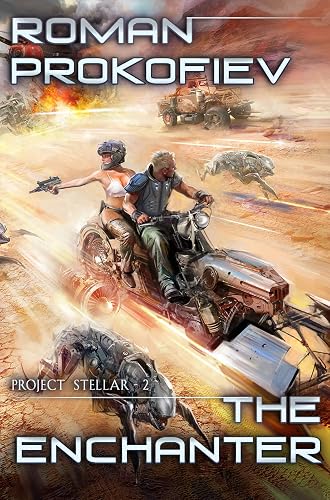


If you liked this, try…
- Solo Leveling (Chugong) — fantastic on its own but with some translation issues; Project Stellar may be the cleaner translation
- Defiance of the Fall (TheFirstDefier) — the long, multi-chapter fight done well; Project Stellar is the opposite, where fights are short because the world is that deadly
Content notes
Post-apocalyptic violence, frequent deaths of the protagonist, and torture for information by the antagonists, not dwelt on in detail but not softened either.
Frequently asked questions
What is Project Stellar about?
Doesn't respawning into new bodies make him unkillable?
How is the translation?
Is it long and grindy?
Read next
Worth the Credit verdicts (B-tier and above). Scroll the carousel for more.