Cultivation

Heretical Fishing Review: When the Pokémon Outpace the Story

Reviewed Updated 7 min read

The verdict C-peak
Not Worth the Credit Ongoing
Narrator
Heath Miller
Series
Heretical Fishing — Book 1
Runtime
23 hrs 56 min
Tropes
isekai, cultivation, slice of life, cozy fantasy, animal companions, reluctant hero, slow-burn romance, humor, forbidden knowledge
Sub-genre
Cultivation
Publisher
Podium Audio

The premise

Fischer isn't a hero. On Earth, he was the scion of a wealthy family who inherited his father's company, discovered it operated unethically, ran it into the ground trying to clean it up, and became the public laughingstock in the process. Burned out and hounded by the press, he does what any reasonable person would do: takes up fishing to clear his head, drives to the water, and gets hit by truck-kun before he's caught more than a handful of fish.

He wakes up isekai'd into a new world where, in a stroke of true fortune, the land right by the ocean is cheap and unwanted. Because in this world, it's heretical.

The backstory explains the theology: the ocean gods did something terrible to the people of the land long ago, and since then fishing has been forbidden. The people of this world don't fish, don't eat seafood, don't touch the sea if they can help it. Fischer, keeping his Earth hobby as his identity in the new world, buys the waterfront property no one wants, builds a modest beachside life, and fishes.

What he doesn't expect is what happens when he eats what he catches.

The world has cultivation: a system where rare individuals can refine their bodies and chi into something approaching godhood. It turns out the ocean life in this world is saturated with chi in ways no one understands, because no one has been fishing long enough to find out. When Fischer eats his catch, he starts cultivating. When he feeds it to people who trust him, they cultivate too. When the animals around his stretch of coastline are exposed to the ambient chi of someone actually engaging with the forbidden sea, they begin awakening, becoming sapient, becoming cultivators themselves.

None of this is what Fischer wanted. He wanted to fish.

What works: Fischer, the world, and two very good companions

The series earns its reputation in Book 1. Haylock Jobson is a good prose writer, not just competent for the genre, but good in an absolute sense. The scenes breathe, the humor lands, and Fischer is the kind of protagonist who is simply easy to be around. He's not burdened by trauma or driven by ambition. He wanted a hobby, and the slow accumulation of reasons why that's harder than it should be carries the story without ever feeling like a grind. He's the neighbor you could spend an afternoon with and not need conversation to fill every gap.

The worldbuilding premise is strong enough to sustain real interest across a full book. A cultivation world that has spent centuries without ocean chi, where the maritime tradition has been extinguished by religious fear, is a interesting setup, and Jobson uses it well. The cultivator politics building in the background, the king's systematic capture of powerful cultivators to prevent challenges to royal power, the cults and noble factions watching Fischer's little corner of the world with increasing concern: all of it develops slowly and gives the cozy slice-of-life tone a structural backbone that keeps it from being consequence-free. Something is coming. The story knows it. Fischer doesn't want to think about it. That dynamic works.

The romance is charming enough, even where it strains credulity. That the first person Fischer meets in the new world becomes his love interest is a coincidence the story leans into rather than trying to justify, and the cozy register gives it permission to do so. The stern father figure is more ham-fisted than it needs to be. But neither element is offensive. They read as an author who enjoys genre conventions, and within this setting that's a defensible choice.

The early animal companions work well. Corporal Claws, the crab and Fischer's first awakened companion, is the best of them: distinctive, composed, and specific enough to function as a authentic supporting character rather than a recurring bit. The lightning otter, Fischer's second companion, pairs well. Where Claws is formidable and dignified, the otter is mischievous and kinetic, and the two of them balance each other in a way that adds texture to every scene they share. When the cast is Claws, the otter, Fischer, and the small human community around his stretch of coastline, the series has a ratio that works. The animal chapters earn their page time. The story can breathe.

That ratio does not hold through the middle of Book 2.

The turn: the Pokémon problem

Here is the dynamic as plainly as I can state it: once the animal companion cast grows past two, each new companion is more derivative than the last, and the chapter rotation required to service all of them displaces the story the series was originally telling.

The additional animals are not badly written. A rabbit who resolves every problem with a roundhouse kick, a lobster, and companions beyond those: all of them are charming in the way the first two were charming. The issue is that they don't add anything Claws and the otter didn't already cover. By early Book 2, Fischer has somewhere between five and six sapient animal companions, and the series is allocating proportional chapter time to each of them in sequence. You finish one companion's developmental arc, and then you go to the next, and then the next. The story doesn't forget about its other elements; it just has less time for them.

The underlying limitation isn't a writing failure. It's structural. Claws and the otter work partly because they're still, at their core, animals: they understand Fischer and he understands them, their social complexity is real within the bounds of what they are. But those bounds are real. When the cast is small, you haven't hit the ceiling yet. When you have six companions rotating through POV chapters, every new arc is running up against it, and the chapters start to feel same-y in a way that dilutes the momentum the series had built. The companions are loyal protectors of Fischer, beholden to him and focused on preserving his way of life. That's a coherent role. It's also a limited one, and six companions doing variations on it takes up a lot of pages.

The actual plot (the cultivator politics, the king's expanding reach, the slow-burning religious conflict) doesn't disappear. It slows to a crawl. By mid-Book 2, more chapter time is going to individual animal development arcs than to Fischer, the human secondary cast, and the stakes that had given the story its structural weight. That's when I stopped. Not in frustration, exactly, but because the thing I wanted to hear had been crowded out, and I didn't want to sit through the next animal chapter enough to get back to it.

The Beware of Chicken comparison

Beware of Chicken is the obvious comparable and the honest one. Same cozy isekai structure: protagonist drops into a cultivation world, wants nothing to do with the hierarchy, settles somewhere remote, and builds a quiet life that the world keeps trying to invade. Same animal companions who develop cultivation powers. Same slow-burning stakes accumulating in the background while the protagonist does his best to ignore them.

The difference that matters most is the animal cast. Casualfarmer's disciples, Bi De the rooster first among them, eventually achieve true human-level sapience and human form. That transition gives each of them clear narrative range. Bi De is more than a loyal protector; he has an inner life, a cultivation philosophy built around the phases of the moon, a relationship to the farm that carries real weight. The ceiling on his character is as high as any human character's ceiling, because in a meaningful sense he has become one.

Claws is distinctive and well-drawn, and she's still a crab. The ceiling on a cultivation crab's inner life is lower, not impossibly low, but lower. When Beware of Chicken adds disciples to its roster, each new addition has room to be fully itself. When Heretical Fishing adds companions past the first two, the diminishing returns become hard to ignore. The later additions feel derivative not because they're written carelessly but because there isn't much new territory left for them to occupy.

None of this is a universal verdict. The Heretical Fishing fan community includes plenty of readers who point to the growing companion cast as the series' greatest strength, who love it more with each new arrival. If animal companions with distinct personalities cycling through their development arcs is your ideal story, my read of this series will not predict yours. You may well stay delighted all the way through. This review represents the other side of that divide. Whether the comparison to Beware of Chicken lands as a reasonable critique or an unfair benchmark will depend on which reader you are.

The verdict

C-peak. Not Worth the Credit — not because the series is bad, but because I stopped, and C tier is where a series goes when I stopped.

Almost all of Book 1 is very good. The writing quality is high, Fischer is an easy protagonist to spend time with, the cozy tone is well-executed, and the worldbuilding premise is interesting. The two early animal companions work. The slow-burning background stakes give the story weight without overwhelming its register. If the companion roster had stopped growing after Claws and the otter, and the chapter ratio had held at Book 1 levels, this rating would be different.

By mid-Book 2, the ratio had shifted in a direction I didn't want to follow. C-peak is the honest result. The plan is to revisit: to go back and skip the companion-focused chapters and see whether the plot, the worldbuilding, and the human cast can carry the series on their own. If that experiment works, the rating goes up.

Until then: if you want the best version of this cozy isekai niche, Beware of Chicken is the credit to spend. If you've already been there and you want more of the same vibe, Heretical Fishing has enough going for it in Book 1 that starting is reasonable. Just know going in whether you're the reader the companion cast will delight or the reader it will exhaust because that answer will determine your experience more than anything else about this series.

Reviewed through mid-Book 2. Series ongoing at 5 books.

Reading order

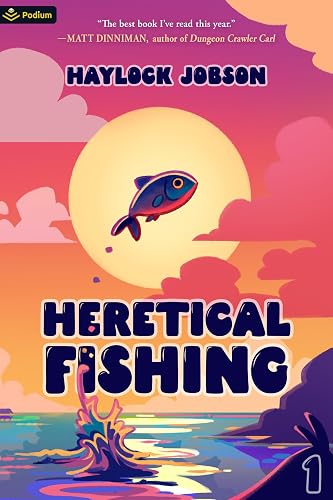
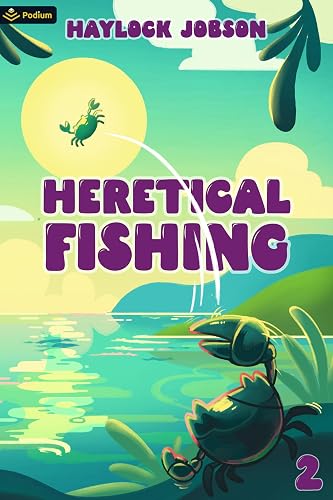
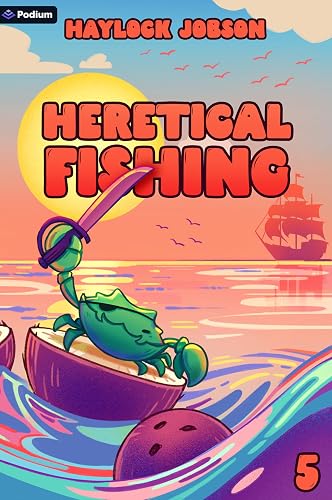
Books in publication order. Cover links go to Amazon, affiliate-tagged, so you get the book and we get a small cut.

If you liked this, try…

  • Beware of Chicken — same cozy isekai structure, same protagonist who just wants a quiet life while the world intrudes; Beware of Chicken executes every element at a meaningfully higher level; start there

Content notes

Mild combat violence; cult activity and political conflict in the background. The overall tone is cozy and warm throughout.

Frequently asked questions

Why C-peak for a series you mostly liked in Book 1?
C tier means stopped; C-peak is the highest a series can rate if I didn't continue. I enjoyed almost all of Book 1 and dropped in the middle of Book 2. That's a C-tier series, but the quality of Book 1 pushes it to the top of the tier. C-peak isn't a dismissal. It's a stopped series with a strong first entry and real reasons to revisit.
Is the Pokémon criticism fair if you like animal companions?
Probably not. This is a preference-driven verdict, and I'm upfront about that. If the growing cast of intelligent, combat-capable animal companions is what draws you to this niche, you will likely enjoy Heretical Fishing more as the cast grows, not less. My read of the series will not predict your experience. This is one of those cases where the review is really describing a personal preference split, and you need to know which side of that split you're on before the rating means anything to you.
How does it compare to Beware of Chicken?
Same niche, same cozy isekai structure, same animal companions developing cultivation powers. The key difference is depth: in Beware of Chicken, the animal disciples eventually achieve human-level sapience and human form, which gives them narrative range that Heretical Fishing's companions don't quite reach. The Beware of Chicken roster is also smaller and tighter, with stronger individual characterization per animal. Heretical Fishing is the closest relative; Beware of Chicken is the better version. Start there and work backward.
Is the slow-burn romance worth it?
Yes, if the trope appeals to you. It's a bit contrived in setup: the first person Fischer meets in the new world becomes his love interest, which stretches coincidence, and the stern father figure is ham-fisted enough to notice. But neither element is offensive, both fit the cozy tone the series is going for, and the romance is a real thread running through the story rather than a nominal attachment. It earns its moments.