LitRPG
System Universe Review: Start Here, Stop at the Trials
- Narrator
- Adam Verner
- Series
- System Universe — Book 1
- Runtime
- 12h 29m
- Tropes
- system apocalypse, isekai, dual system, overpowered protagonist, slice of life, animal companion, city building, multiverse
- Sub-genre
- LitRPG
- Publisher
- Aethon Audio
The premise
Derek Hunt survives Earth's system integration by being the kind of person who didn't need anyone's help before the monsters arrived and doesn't need it now. Then, on a mission he almost talks himself out of, he gets pulled through a rift into a completely different world, one with its own system. The new system registers his Earth stats, preserves them, and resets his level to 1. He arrives with better attributes than anything native to this world can account for, carrying equipment and titles the local system doesn't have context for, at a level low enough to look manageable. The first book is about Derek working out what that combination actually means.
Back on Earth, the system is looking for the asset it lost. Above everything, administrators and higher powers maintain the spaces between systems, present but not yet central. The dual-system concept is the series' best idea, and System Change is the most interesting the idea ever gets.
Why the early books work
Book 1 is the best book in the series. Not by a small margin.
The premise requires Derek to think about his situation before he can act on it, and the thinking is engaging. What does "level 1 but stats intact" actually mean in a world where level determines what abilities unlock? What happens when you try to use a title earned on Earth inside a completely different system? How does he explain his abilities to a world that has no reference frame for what he came from? The theory crafting here is doing real narrative work: it's the process by which Derek figures out what he is, and each discovery reshapes what's possible.
By Book 2 (Torith), he's moved from the village where he landed to his first city. The world expands, the secondary cast begins to fill in, and the core dynamic (Derek is simply much stronger than anything around him, and must navigate a world that doesn't know this) is still producing interesting situations. Book 3 (Savannah) carries the momentum further. He puts down roots, builds a shop, establishes himself in a city. The slice-of-life elements that will eventually dominate the series are already present, but they're still earned; they feel like a reward for the hard work of Books 1 and 2.
My recommendation is to give this series three books before you decide. Books 1–3 are A-tier work. If you're not enjoying it by the end of Savannah, the series isn't for you. If you are, make a deliberate choice at Book 4. I'll tell you why.
The cast problem
Here is the series' structural flaw, and it compounds over time.
Derek is so powerful that the secondary cast cannot do anything he couldn't do better. They exist in his orbit: handling functions he's delegated, practicing skills he's already mastered, becoming diminished reflections of what he represents. As the cast grows, this problem grows with it. By the middle books, you have four or five companions taking up substantial page time without collectively affecting the direction of anything.
Thomas is Derek's apprentice. He trains to use a spear. He grows. He eventually goes off to an academy. Nothing about his arc changes what happens in the story in any way that matters.
Brandi handles crafting. She's slightly more interesting than Thomas: the crafting mechanics have some novelty, but her function is to produce items for Derek's operation and to give the narrative a reason to dwell on item creation. Remove her from the series and nothing changes.
The series also has the obligatory "former enemy turned loyal subordinate" character, brought into the fold after Derek spared him. He ends up running a contracting operation. He takes up page time. He doesn't matter.
Then there's Alanah Swan. She's the exception. She's the most developed secondary character in the series: the one whose scenes have actual stakes, the one whose relationship with Derek feels reciprocal rather than hierarchical. She's what the rest of the cast should be. When she ascends and leaves Derek's world in System Clash (Book 8), the series loses its most valuable non-Derek asset. Her departure is essentially my stopping point, and it's not a coincidence.
The irony that makes all of this starkest: the most interesting character in System Universe, after Derek, is Silvi. Not any of the humans. The bunny. Silvi, Derek's soulbound void bunny with ambitions to become a chef, has a concrete, consistent, non-two-dimensional personality. Her running dynamics with Derek are specific and reliable. When she matters to the story, she actually matters. She's the proof that SunriseCV can write compelling secondary characters. Which makes the blandness of the human cast harder to excuse.
The theory crafting gap
The series positions Derek as a theory crafter: someone who thinks systematically about what the system allows, finds edges other people miss, and wins by applying them in ways his opponents haven't prepared for.
This characterization doesn't quite land.
Compare Derek to Felix in Unbound: Felix competes against opponents who physically outclass him. His theory crafting is load-bearing. It is the mechanism by which he wins. When his read on the system is wrong, he loses. The readers and listeners are actively watching a mind work, and the conclusions are surprising even when the outcome isn't. Or compare him to the protagonist of Divine Apostasy, another Royal Road series in this vein, where theory crafting defines how the character approaches every problem and is the source of his edge against superior fighters.
Derek's theory crafting is different in kind. His real advantage is that his stats are already enormous, his equipment is beyond anything this world has seen, and he accrued titles on Earth that the local system doesn't have context for. The theory crafting gets layered on top as a personality trait. He thinks about how the system works, he has opinions about builds and ability interactions, but it's flavoring rather than function. He doesn't need to out-think opponents. He simply out-powers them, and then the theory crafting explains why his overwhelming victory was actually clever.
This isn't fatal to the series; plenty of LitRPG protagonists win through raw power and remain compelling. The issue is the gap between what Derek is billed as and what he actually is. If you go in wanting the real theory-crafter experience, look elsewhere first.
The combat problem
When top-tier fighters face each other in the later books, the power levels behave inconsistently.
Abilities that should be decisive require multiple applications to land. Effects that worked definitively in one scene don't carry over to the next encounter. Characters who should be able to one-shot each other suddenly need extended exchanges, not because the system has made them more durable since we last saw them, but because the scene requires more runtime before the outcome arrives.
This is a specific frustration in LitRPG, because one of the genre's core promises is that the numbers should tell you something. A world governed by a system is supposed to make power comparisons more legible than in conventional fantasy. When the system establishes what should be a definitive application of force and the author walks it back because the story needs more fight, the premise is undermined. The system exists to be believed. When it isn't, when it becomes set dressing rather than rules, the thing that makes LitRPG distinctive starts to feel hollow.
The late-book war arc compounds this with a related problem: nobody meaningful dies. The opposing faction's top fighters survive because "no one wants to kill the other side's best talent." This is a reasonable in-universe position, and SunriseCV writes it as such. But the narrative effect is consequence-free stakes. Early Derek would end an enemy who needed ending. Later Derek operates in a world where the cost of conflict at the top of the power chart has been functionally removed. The series has leveled up past its willingness to pay what escalating conflict should cost.
The inflection point: Trials of Cydaria
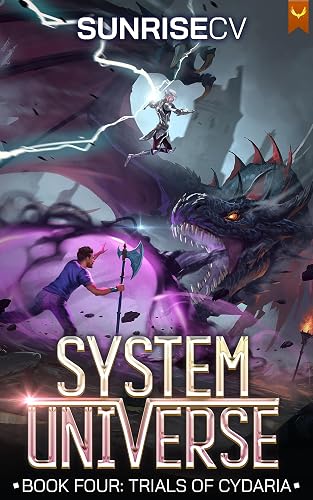
Trials of Cydaria (Book 4) is where the series changes shape. This is the recommendation boundary.
The Trials arc functions as an extended side quest. Derek and his companions navigate a competition that takes them away from the macro threads for most of the book. A large portion of the throughline involves everyone catching and bonding with dragons until basically the whole group has one. The world-building expands: the Cydarian kingdom gets fleshed out, new factions are introduced, but the expansion serves the immediate adventure rather than the series' larger questions.
The macro elements (Earth's system looking for Derek, the two systems eventually meeting, the administrators managing the multiverse in the background) don't advance. The secondary cast gets more time without getting more depth. The questions Book 1 raised are still unresolved, and the book isn't moving toward them.
This is the moment System Universe decides it's more interested in slice-of-life accumulation than in the intersystem thriller it gestured toward in System Change. It doesn't pivot back. By the later books, plot movement is concentrated in the prologue and epilogue. Everything in between is daily life in Savannah with characters who don't change anything.
Enjoy Books 1–3. Then make a deliberate decision. If the expanding world and the companions are working for you, keep going. There's still enjoyable material in the war arc. But go in knowing what the series has become by this point, and that the drift is structural rather than temporary.
What keeps the door open
I stopped at System Clash (Book 8), after Alanah Swan ascends and leaves Derek's world. But I haven't ruled out going back, and that's unusual for a series I've rated this low.
The reason is the macro elements that haven't been paid off yet. Earth has been without Derek for the entire run of the series: eight books, roughly forty years of publication calendar. The system that integrated Earth is still active there. The asset the system lost is still missing. The two systems are presumably going to interact eventually, and that story hasn't been told yet. The administrators who manage the multiverse remain mysterious in ways that feel intentional rather than undeveloped.
These threads represent what System Universe could be, and they're strong enough to make me curious even after the series spent eight books mostly not advancing them. A version of this series that made the dual-system premise its organizing principle (Earth's system as persistent antagonist, the multiverse administrators as true faction, the meeting of two systems as a climax worth building toward) would be a different kind of series. It might have been an S-tier series.
What exists is C-peak. The potential is real. That gap is its own kind of thing to sit with.
The narration — Adam Verner
Verner handles all eight books, which is a substantial commitment to a single voice for a long-running series. He's a solid, reliable choice: the pacing is comfortable, the character voices are consistent across the run, and the slice-of-life material, which is easier to mishandle than action, lands without overstaying its welcome. He's not a show-stealer in the way the best narrators on this site are, but he fits the series without friction, which matters across 130+ hours.
Verdict
C-peak. Not Worth the Credit.
The C is for stopped: meaningful structural flaws that compound over time. The peak is for the opening, which is excellent. Books 1–3 are A-tier. System Change in particular is one of the stronger first entries in LitRPG: the dual-system premise is original, the theory-crafting setup is more interesting here than it will ever be again, and the book earns every page. The secondary cast isn't the problem yet. The macro questions are still alive and pulling.
Then the series drifts: cast bloat with no payoff, consequence-free combat at the top of the power chart, slice-of-life stretches that feel like comfort food rather than story. The inflection point is Trials of Cydaria. Stop before it or go in knowing what you're signing up for.
Start with Book 1. Enjoy Books 2 and 3. Make a deliberate decision at Book 4.
Silvi is the best character. That part stays true all the way through.
Reading order
Books in publication order. Cover links go to Amazon, affiliate-tagged, so you get the book and we get a small cut.
If you liked this, try…
- Unbound — Felix's theory crafting is the actual mechanism by which he competes; Derek's version is window dressing layered over raw power
- Portal to Nova Roma — shares the same structural tension: an overpowered MC whose gap from the secondary cast makes everyone else feel like diminished reflections
- Divine Apostasy — the other strong theory-crafter protagonist; no audiobook review on site yet, but the comparison is worth making
Content notes
Combat violence throughout, including large-scale warfare in Books 5–6. Standard genre-level darkness. No extreme content.
Frequently asked questions
Are the first few books worth it despite the C-peak rating?
Where should I stop if I start?
Is the theory crafting aspect as engaging as in other LitRPGs?
Why C-peak and not something lower?
Read next
Worth the Credit verdicts (B-tier and above). Scroll the carousel for more.